|
Vitesse des vents à 925 hPa
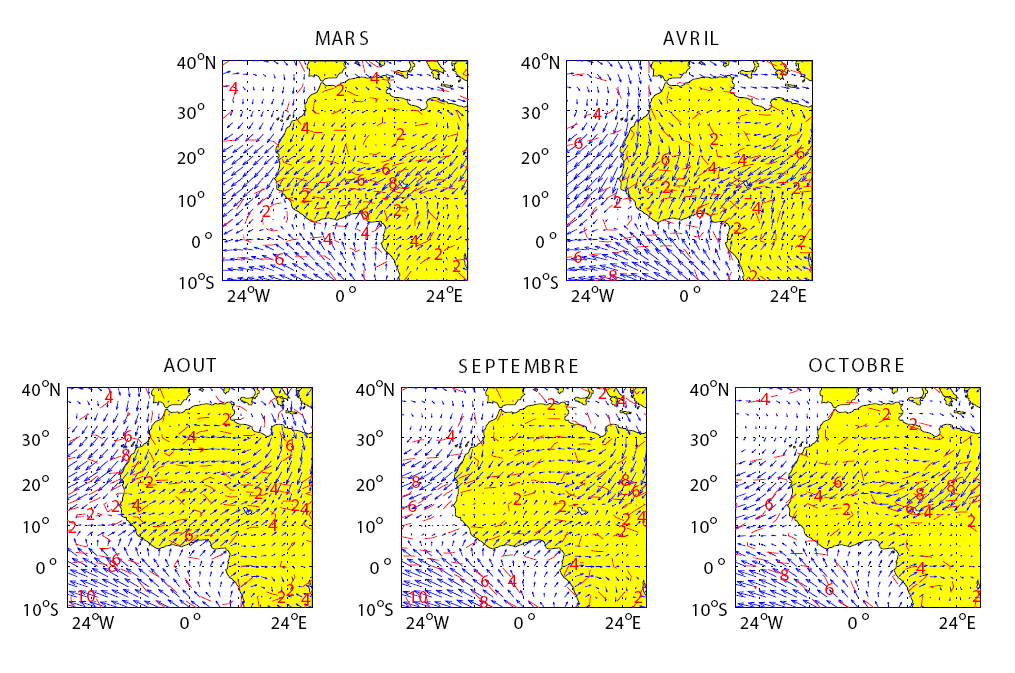
La ZCIT coïncide avec le minimum de pression en surface, zone où les alizés convergent près du sol. Cette convergence des basses couches favorise la convection nuageuse. L'intensité du flux de mousson est liée aux vents, d'autant plus forts que la différence de pression est grande entre les hautes pressions de l'anticyclone de Sainte-Hélène et les basses pressions du Sahara. On se place à 925 hPa pour s'extraire des effets de rugosité et du relief. La vitesse des vents s'exprime en m.s-1. Les cartes suivantes illustrent les variations saisonnières des vents sur l'Afrique de l'Ouest et Centrale. Les flèches symbolisent la direction des vents (combinaison des composantes méridienne et zonale). Plus les vents sont forts, plus la flèche est apparente.
|
 |
|
Variations mensuelles moyennes de la vitesse des vents à 925 hPa sur l'Afrique sur la période 1968 1998. |
 |
 Fermer cette page
 Imprimer cette page